-
What types of metal frames are used for drywall installation?
There are two main types of drywall framing systems: wall framing systems (used for wall cladding and partitions) and ceiling framing systems.
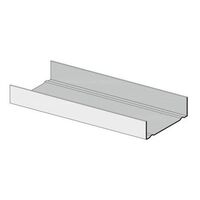
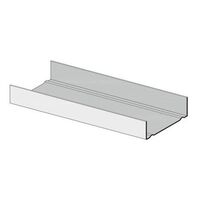
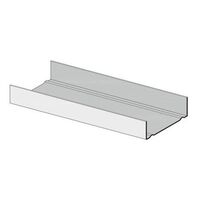
Wall frames are installed using metal CW studs, which are inserted into UW tracks.
Ceiling frames are assembled from CD load-bearing profiles, suspended from the structural ceiling, and UD perimeter profiles, installed along the walls.
Each system uses corresponding hangers, connectors and fastening elements.
-
What profiles are used for drywall wall installation?
For wall cladding (without building a full partition), installers often use CD ceiling profiles as vertical studs and UD profiles as guides along the floor and ceiling.
This creates a lighter and thinner structure.
For a full partition wall with a larger offset from the base wall, the standard partition profiles are used:
UW — guide profile
CW — stud profile.
-
What profiles are used for ceiling installation?
The main components of a drywall ceiling frame are:
CD 60×27 mm — load-bearing profile suspended from the structural ceiling with hangers
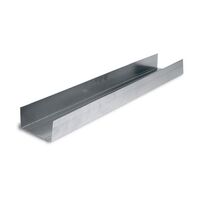
UD 28×27 mm — perimeter guide profile fixed to the walls.
CD profiles are installed parallel with a spacing of 500 mm, while cross CD profiles are installed with a spacing of 600 mm.
For two-level ceilings, an additional CD level is installed using extended hangers or connectors.
-
What elements are used in drywall partition framing?
A drywall partition is assembled from:
UW profiles — guide tracks fixed to the floor and ceiling
CW profiles — vertical studs installed with spacing of 400 or 600 mm.
Additional elements include:
horizontal crossbars (headers) made from UW profiles
reinforced studs around door openings
embedded supports for equipment or furniture
acoustic sealing tape installed under all guide profiles that touch floors, ceilings or walls.
-
What are the standard drywall profiles — UW, CW, UD, CD?
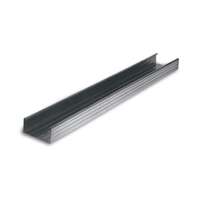
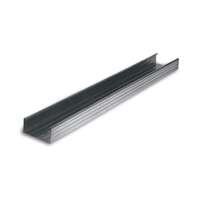
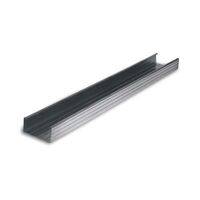
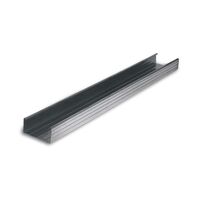
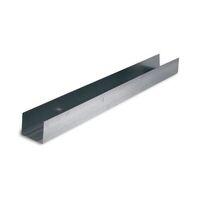
UW (U-Wall) — partition guide profile with a U-shaped cross section, fixed to floor and ceiling.
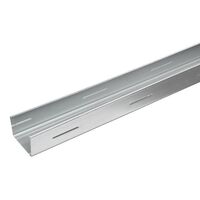
CW (C-Wall) — partition stud profile with a C-shaped cross section, inserted into UW guides.
UD (U-Decke) — ceiling perimeter guide profile fixed along the walls.
CD (C-Decke) — load-bearing ceiling profile suspended from the structural ceiling.
These designations correspond to the European standard EN 14195.
-
What stud spacing should be used — 400 mm or 600 mm?
A 600 mm spacing is acceptable for simple partitions with a single drywall layer in residential rooms with low loads.
A 400 mm spacing is required in the following situations:
ceiling structures
double-layer drywall cladding
bathroom and humid environments
walls with ceramic tile finishes
fire-rated and acoustic partitions
partitions higher than 3 meters.
-
When should a double partition frame be used?
A double frame system (two separate rows of CW studs mounted in separate UW tracks) is used when high sound insulation is required.
Typical applications:
partitions between apartments
walls between bedrooms and bathrooms
recording studios
home theaters.
The gap between stud rows breaks the acoustic bridge.
Combined with mineral wool insulation and double drywall layers, such a structure can achieve Rw 50–55 dB, compared to 40–42 dB for a single frame.
-
How should the frame be reinforced for a door opening?
Studs on both sides of the door opening are reinforced by:
inserting a wooden beam 40×60 mm inside the CW profile, or
installing two CW profiles back-to-back, fixed together with 3.5×25 mm screws.
The header above the door is made from a UW profile.
The sides of the profile are cut and bent 90°, forming support tabs that are fixed to the studs.
This reinforcement absorbs the dynamic load from the door and prevents deformation.
-
What profiles should be used for reinforced partitions (for kitchen cabinets)?
When heavy equipment such as kitchen cabinets is mounted on the wall, additional reinforcement is required.
Possible solutions:
install wooden blocks (40×40 mm or 50×50 mm) between CW studs
or use CW profiles with 0.6 mm steel thickness and 400 mm spacing.
The position of embedded supports should be marked on the layout before drywall installation.
Fastening heavy furniture directly to drywall without reinforcement is not recommended.
-
Which profile is the guide and which is the load-bearing one?
In partition systems:
UW — guide profile (horizontal, fixed to floor and ceiling)
CW — load-bearing stud (vertical).
In ceiling systems:
UD — perimeter guide profile
CD — load-bearing suspended profile.
-
What fasteners are used for a single-level ceiling?
A direct U-shaped hanger is typically used for a single-level suspended ceiling.
The hanger is fixed to the structural ceiling with a 6×40 mm anchor or dowel and supports the CD load-bearing profile.
Typical installation parameters:
hanger spacing along the profile: 600–900 mm
CD profile spacing: 500 mm
The hanger “wings” are bent downward, the CD profile is inserted between them and fixed with LB 3.5×9.5 mm screws.
This system is simple, fast and reliable, suitable for lowering ceilings up to approximately 120 mm.
-
What fasteners are used for a two-level ceiling?
For a second ceiling level or when the ceiling needs to be lowered more than 120 mm, adjustable hangers are used.
Typical types:
hanger with threaded rod
wire suspension anchor system
These systems allow ceiling drops of up to 1000 mm.
The first level of CD profiles is suspended from the structural ceiling.
The second level of CD profiles is attached to the first level using cross connectors (crabs) or special connectors.
This solution allows the creation of multi-level ceilings and provides space for engineering systems such as ventilation, wiring or lighting.
-
What is the difference between single-level and double-level ceiling frames?
Single-level ceiling system
all CD profiles are located in the same plane
cross profiles are connected with crab connectors
minimal ceiling drop.
Double-level ceiling system
the first level of CD profiles is suspended from the structural ceiling
the second level of CD profiles is mounted below the first level.
This system provides higher rigidity and allows more space for utilities.
-
What is the recommended spacing of CD profiles in ceiling installation?
The standard spacing is:
500 mm between main CD profiles
This allows three fixing lines for a standard 1200 mm drywall sheet (edges and center).
Cross CD profiles are installed with 600 mm spacing.
For double-layer drywall ceilings, the spacing of main CD profiles should be reduced to 400 mm due to increased load.
The spacing between hangers along each CD profile should not exceed 900 mm.
-
What is the maximum span of a ceiling frame without additional support?
For a CD 60×27 mm profile, the maximum recommended spacing between hangers is 900 mm.
Exceeding this distance may lead to:
profile deflection
cracks in drywall joints.
When using two layers of drywall, hanger spacing should be reduced to 600 mm.
The maximum free span of a CD profile without a hanger should never exceed 1200 mm.
-
What types of hangers are used in ceiling systems?
The most common types are:
Direct hanger
used for ceiling drops up to 120 mm
Adjustable hanger (hanger with rod)
used for ceiling drops between 120–400 mm
Wire suspension anchor
used for ceiling drops up to 1000 mm
All hangers are fixed to the structural ceiling with anchor dowels or hammer-in anchors (6×40 mm).
The load capacity of a direct hanger is typically up to 25 kg per fixing point.
-
When is a crab connector used?
A crab connector (single-level cross connector) is used in two main situations:
When two CD profiles intersect in the same plane, ensuring a rigid connection.
In double-level ceiling systems, where the lower CD profile level is attached to the upper level.
The crab snaps onto the main CD profile.
The cross profile is inserted into the connector and fixed by bending the tabs and adding LB screws.
Without a crab connector, the intersection of profiles would be structurally weak.
-
When is a profile extension connector used?
A CD profile extension connector is used when the standard profile length (3000 mm or 4000 mm) is not sufficient.
The connector is inserted inside both profiles with an overlap of at least 200 mm and fixed with screws.
To maintain structural strength:
joints of adjacent profiles should be staggered by at least 600 mm.
This prevents creating a weak structural point in the frame.
-
What fasteners are used for concrete, brick and aerated concrete bases?
Concrete and solid brick
hammer-in dowel 6×40 mm
plastic dowel with screw.
Hollow brick
butterfly anchors
special anchors for hollow materials.
Aerated concrete
Standard dowels often fail in this material, therefore:
special nylon anchors for aerated concrete
or chemical anchors should be used.
-
What dowels are used to fix guide profiles to floors and ceilings?
The most common solution is a 6×40 mm hammer-in dowel.
Installation rules:
fixing spacing: maximum 1000 mm
distance from the profile end: 150–200 mm
A hole with 6 mm drill bit must be pre-drilled.
The guide profile should be installed over acoustic sealing tape without tearing it.
For aerated concrete bases, spacing should be reduced to 500–600 mm and longer anchors should be used.
-
How should metal profiles be connected to each other?
When installing CW studs into UW tracks, additional fasteners are usually not required. The CW profile is simply inserted into the UW track and held in place by the pressure of the profile flanges.
However, the following elements must be fixed with fasteners:
horizontal crossbars
reinforced studs
corner joints
T-shaped connections.
These connections are typically fixed using:
LB 3.5×9.5 mm screws (self-drilling screws)
or a profile punch tool (crimping pliers).
Structural joints should have at least two fixing points on each side.
-
When should screws be used and when should a punch tool be used?
A profile punch tool (metal crimping pliers) is often used in large installations because:
it is fast
it requires no additional screws
the connection remains flush with the profile surface
it does not interfere with drywall installation.
Self-drilling screws (LB) are used when:
the installer does not have a punch tool
the construction may need to be disassembled
stronger structural connections are required.
For reinforced connections such as double studs or headers, screws are preferred.
-
What screws are used for connecting metal profiles?
The most commonly used screws are:
LB 3.5×9.5 mm
(also called “bugle screws” or “tek screws”)
They are used for:
profile-to-profile connections
fixing hangers to CD profiles
attaching connectors such as crab connectors.
For reinforced connections (for example, two CW profiles back-to-back), 3.5×25 mm screws are used.
Screws designed for wood or roofing should not be used, as their thread pitch is too large and may deform thin metal profiles.
-
What screw sizes are used for frame connections?
Typical screw sizes:
3.5×9.5 mm — standard profile-to-profile connection
3.5×11 mm — connection with accessories such as hangers or connectors
3.5×25 mm — reinforced connections between two profiles.
In suspended ceiling systems using rod hangers, M6 threaded rods and nuts may also be used depending on the hanger type.
-
What screws are used for fastening drywall to metal frames?
Drywall is fixed to metal frames using TN drywall screws (Trockenbau screws) with fine thread and countersunk heads.
Common sizes include:
TN 3.5×25 mm — for single-layer drywall
TN 3.5×35 mm — for the second drywall layer
TN 3.5×45 mm — for fastening two drywall layers at once.
Wood screws with coarse thread should not be used because they may tear the drywall paper surface.
-
What screw length should be used for drywall?
The minimum screw length is calculated as:
drywall thickness + at least 10 mm penetration into the metal profile.
Typical examples:
drywall thickness 12.5 mm → screw 3.5×25 mm
drywall thickness 15 mm → screw 3.5×25 or 3.5×35 mm
double drywall layers 12.5 + 12.5 mm → screw 3.5×45 mm.
The standard screw diameter is 3.5 mm. Larger diameters are not recommended because they reduce holding strength.
-
What screw spacing is used for a single layer of drywall?
Typical installation spacing:
Along sheet edges (joint areas):
150–200 mm
Along intermediate studs:
250–300 mm
Distance from the sheet edge:
at least 10–15 mm.
Average screw consumption is approximately 17–20 screws per square meter.
The screw head must be slightly recessed (0.5–1 mm) below the surface of the drywall paper without tearing it.
-
What screw spacing is used for double-layer drywall?
For the first drywall layer:
screw spacing 250–300 mm along all profiles.
For the second drywall layer:
150–200 mm along edges
250–300 mm along intermediate studs.
The sheets of the second layer must be offset from the first layer:
horizontally by half a stud spacing
vertically by at least 400 mm.
This prevents joint alignment and significantly increases structural strength and sound insulation.
-
What is the approximate profile consumption per 1 m² of construction?
Typical values:
Partition wall (stud spacing 600 mm, single drywall layer):
UW profile — about 0.8 linear meters / m²
CW profile — about 1.8 linear meters / m²
Partition wall (stud spacing 400 mm):
CW profile — about 2.5 linear meters / m²
Single-level ceiling system
(CD spacing 500 mm, hanger spacing 600 mm)
UD profile — about 0.4 linear meters / m²
CD profile — about 2.2 linear meters / m²
direct hangers — about 1.8 pcs / m²
An additional 5–10% should be added to compensate for cutting waste.
-
How many screws are needed per 1 m² of drywall?
For drywall-to-frame fastening (TN screws):
17–20 screws / m² for a single drywall layer
34–40 screws / m² for double-layer drywall.
For profile-to-profile connections (LB screws):
2–3 screws / m² for partition frames
3–4 screws / m² for ceiling frames.
Guide profile anchors:
approximately 1–1.5 anchors per linear meter.
It is recommended to purchase about 10% extra fasteners.
-
How is the quantity of frame materials calculated?
Basic calculation steps:
Determine the total construction area.
Calculate the length of guide profiles (perimeter).
Calculate the number of studs or CD profiles
(width ÷ spacing + 1).
Calculate the number of hangers based on hanger spacing.
Calculate the required fasteners.
For complex rooms, calculations are best done using a frame layout drawing.
-
How can the Knauf calculator be used to estimate frame systems?
Knauf provides an online calculator on its website.
The user selects:
construction type (partition, wall lining, ceiling)
dimensions (height, length)
stud spacing
number of drywall layers.
The calculator automatically generates a complete bill of materials, including profiles, fasteners and drywall.
The result can usually be exported as a PDF and used for price comparison with suppliers such as Sitypro.com.
-
Why is acoustic sealing tape used under the frame?
Acoustic (damping) tape performs two functions:
Acoustic function
reduces vibration and sound transmission between the frame and the structure.
Structural function
compensates for small irregularities in the base surface and improves profile contact.
Without acoustic tape, the metal frame forms a rigid acoustic bridge between metal and concrete, significantly reducing sound insulation performance.
-
Where should acoustic sealing tape be installed?
The tape is applied to the bottom surface of guide profiles:
UW profiles — along floors and ceilings in partition walls
UD profiles — along wall perimeters for ceiling systems.
The tape should be installed before fixing the profiles, and anchors should pass through the tape without tearing it.
Additional tape may be used at wall contact points if the frame touches structural walls.
-
What alternatives exist to acoustic sealing tape?
Possible alternatives include:
polyethylene foam strips (cut from laminate underlayment)
mineral wool strips with density 50–60 kg/m³
rubber vibration pads used in professional acoustic systems.
However, removing the damping layer completely is not recommended when sound insulation is important.
-
How does the frame design affect sound insulation?
The frame structure significantly influences sound insulation performance.
Typical values:
Single frame without insulation
≈ 30–33 dB
Single frame with mineral wool
≈ 40–42 dB
Double frame with mineral wool and double drywall layers
≈ 52–58 dB
Interestingly, reducing stud spacing from 600 mm to 400 mm slightly increases structural stiffness, which may sometimes increase vibration transmission, so proper acoustic design is important.
-
How should the frame be aligned properly?
Installation begins with precise layout marking.
Steps include:
Mark the guide profile lines on the floor using a laser level or chalk line.
Transfer the lines to the ceiling using a laser level or plumb line.
Check stud verticality with a spirit level or laser level.
Acceptable deviation is approximately 1 mm per meter.
Ceiling frames are aligned horizontally using laser plane projection while adjusting hanger lengths.
-
What tools are required for metal frame installation?
Basic tools include:
laser level (preferred) or spirit level
measuring tape
marker or pencil
profile punch tool or screwdriver with PH2 bit
rotary hammer drill with 6 mm drill bit
metal snips or angle grinder for cutting profiles.
Additional useful tools:
square ruler
chalk line
string line for ceiling alignment.
Using a laser level significantly improves installation speed and accuracy.
-
What are the most common frame installation mistakes?
Typical mistakes include:
using 600 mm stud spacing where 400 mm is required
missing acoustic sealing tape under guide profiles
hanger spacing exceeding 900 mm
not reinforcing door openings
aligning drywall joints between layers
screws driven too deep or not deep enough
using profiles with 0.4 mm thickness in structures requiring higher strength.
-
What is the difference between Knauf profiles and other brands?
Knauf manufactures a complete drywall system, including:
profiles
drywall boards
joint compounds
reinforcing tapes.
All components are tested together as a certified system, especially important for fire-rated or acoustic constructions.
Other manufacturers often produce compatible profiles, but not always with full system certification.
For private construction projects, alternative brands are usually acceptable if they meet standard dimensions and quality requirements.
-
How does metal thickness differ between manufacturers?
Typical metal thicknesses:
0.4 mm — budget segment
0.5 mm — standard quality
0.55–0.6 mm — professional systems such as Knauf.
A difference of 0.2 mm may seem small, but it significantly affects structural rigidity.
-
Why does profile thickness affect frame strength?
Profile stiffness increases significantly with metal thickness.
A 0.6 mm profile can be 30–40% stronger than a 0.4 mm profile of the same shape.
In practice:
partitions made from 0.4 mm profiles may flex when pressed
0.6 mm profiles create a much more rigid structure.
For ceilings, tiled walls and fire-rated systems, using profiles thinner than 0.5 mm is not recommended.
-
What alternative frame and fastener brands are available on Sitypro.com?
Sitypro.com offers a range of metal framing components besides Knauf, including products from:
Finnish manufacturers
Estonian manufacturers
Baltic brands.
These profiles are dimensionally compatible with standard drywall systems.
For current availability, sizes and prices contact:
???? +372 536 16980
???? sitypro.com