


Frequently asked questions about the Transition skirting category
What is transition skirting and what is it used for?
Transition skirting is a decorative and functional profile that evens joints between floor coverings (laminate, parquet, tile), protects edges and compensates height differences from about 2–38 mm. Sitypro offers wooden, aluminium and self-adhesive models in lengths of 1–3 m.
Which transition skirting suits laminate?
For laminate use profiles with a groove or self-adhesive base such as B3/38 mm and ISELIIMUV 30–38 mm models. Choose width and profile according to the joint location and laminate thickness.
What sizes and materials are transition skirting available in?
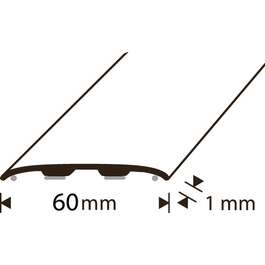
Available lengths are 1–3 m, widths around 30–60 mm and step nosing profiles 25x15, 29x29, 42x22 mm. Materials include natural oak/beech/ash veneer, aluminium and self-adhesive plastic options.
How to choose a transition skirting by floor height difference?
Measure the height difference in mm and pick a profile that covers that range: B3 2–12 mm for 2–12 mm gaps; B2/B1 or 38 mm strips for larger differences. Also consider covering thickness and fixing method.
Are there self-adhesive transition skirting and how to install them?
Yes — ISELIIMUV self-adhesive strips in 30–38 mm thickness and 1–3 m lengths. Clean and degrease the surface, remove the protective film and press the strip along its length for secure bonding.
How do step nosings differ from regular transition skirting?
Step nosings have reinforced profiles and sizes like 29x29 mm or 42x22 mm to protect the front edge of a step. Regular transition strips are wider (30–60 mm) and designed to bridge level differences between floors.
What fixing options are available for transition skirting?
There are self-adhesive types, strips with aluminium mounting bases for screws and snap-on profiles. Choose based on substrate material and whether you need removable installation.
How to match colour and texture of the skirting to parquet or laminate?
Compare veneered or laminated samples — options include oak, beech and natural, light or dark tones. If unsure, pick a strip with a close tone and a universal wood veneer texture.
Are aluminium transition skirting suitable for entrances and wet rooms?
Aluminium resists moisture and wear, so it's suitable for entrances and wet rooms with proper installation and anti-corrosion finish. Verify compatibility with the floor covering and strip thickness.
How to cut and fit wooden strips of 1–3 m?
Cut wooden and veneered strips with a fine-tooth saw or mitre saw to required length; sand cuts and apply varnish if needed. Use installation accessories and leave a small expansion gap.
Which transition skirting suits metering devices mounted on a DIN-rail?
DIN-rail mounted metering devices require specific mounting strips/adapters: the range includes panel mounting profiles and adapters for distribution boxes compatible with aluminium and PVC strips. Check the device model and DIN-rail width before purchase.
Can the same strip be used for room joints and door thresholds?
Some universal profiles (30–60 mm) work for room-to-room joints, but for door thresholds with heavy traffic choose reinforced aluminium or dedicated threshold and step nosing models.
New Arrivals in the Transition skirting Category in 2026
- TRANSITION STRIP B1-2M 30MM HÕBE DIONE — 17.03€
- VUUGILIIST B2-1M 38MM KULD DIONE — 10.39€
- VUUGILIIST B2-1m 38MM PÄHKEL DIONE — 11.49€
- ÜLEMINEKULIIST B3-1M PÄHKEL DIONE — 13.34€
- ÜLEMINEKULIIST B3-2M PÄHKEL DIONE — 25.75€
Best sellers in the Transition skirting category in 2026
- LÕPULIIST 10X24 2M Oak DIONE — 28.52€
- LÕPULIIST 15X24 1M Oak DIONE — 15.18€
- T-LIIST 15X38 1M Oak DIONE — 16.10€
- NIVOOLIIST 15X42 2M Oak DIONE — 32.20€
- NIVOOLIIST 15X42 1M Oak DIONE — 16.10€
Cheap products in the Transition skirting category
Expensive products in the Transition skirting category
Price of products in the Transition skirting Category
Transition skirting: 5.34€ — 37.10€ (287)