


Frequently asked questions about the Roof colours category
What are Roof colours and what are they used for?
Roof colours are specialized paints for protecting and finishing roofs, improving water resistance, corrosion protection and UV reflectivity. The category includes acrylic, polyurethane and alkyd-based paints suitable for metal, bitumen, tile and fibre-cement (eternit) roofs depending on substrate and exposure.
Which paint in the range is best for a metal roof?
Acrylic and alkyd (oil-based) roof paints from the range are best for metal roofs: acrylic offers strong adhesion and flexibility with temperature changes, alkyds provide very good metal bonding. There are also anti-corrosion formulations with rust inhibitors suitable for older steel roofs.
Can I use an acrylic roof paint on fibre-cement (eternit) or tile roofs?
Yes, acrylic roof paints in the category are suitable for fibre-cement and tile roofs because of their good adhesion and vapour permeability. Clean, dry and, if necessary, primed surfaces before painting will improve adhesion and longevity.
What's the difference between FASOLITE A 2.7L and FASOLITE A 9.9L?
FASOLITE A 2.7L and 9.9L are the same product in different container sizes: 2.7 L is convenient for small repairs or spot work, while 9.9 L is better for large areas or whole-roof repainting and reduces the need to open multiple containers.
What is the coverage of KATUSEVÄRV RILAK ETERNIT ROOF 3.6L?
Coverage varies with substrate condition, but Eternit Roof-type paints typically cover about 100–150 g/m² per coat; check the product technical data sheet for exact figures. Measure your roof area and plan for 1–2 coats depending on hide and surface porosity.
Is primer required before applying Roof Paint KATTO A 9L?
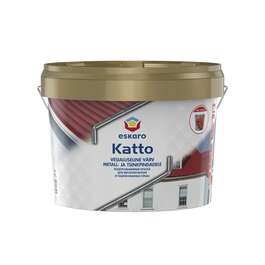
In most cases priming is recommended before applying KATTO A 9L, especially on porous or previously unpainted substrates. A primer improves adhesion, evens out absorbency and extends the life of the topcoat.
How should I prepare the roof surface before painting with acrylic paint?
Clean the surface of dirt, moss and rust; prime porous or metal areas; repair cracks and remove loose old coatings. Apply paint at the manufacturer’s recommended temperature and humidity, and use 1–2 coats with proper drying time between coats.
Is there an anti-slip additive in the range for roof walkways and steps?
Yes, the range includes LIUKUESTE 0.33L — an anti-slip additive that can be mixed into paint to create a non-slip surface for roof walkways and steps. Use according to the manufacturer’s dosing instructions to maintain adhesion and colour.
Which paints retain colour best under UV exposure?
Acrylic roof paints in the range offer good colour and UV resistance, helping shades remain vivid for years. Look for product descriptions mentioning UV stability or fade resistance; the Finnish Kattomaalit line specifically highlights UV durability.
Which paints are best for industrial roofs with chemical exposure?
Polyurethane and epoxy systems are preferred for industrial roofs facing chemical and mechanical stress. These formulations provide superior chemical resistance and mechanical durability compared with standard acrylics.