


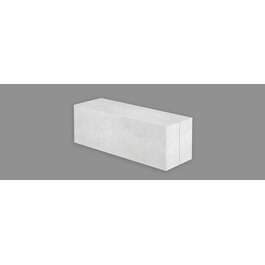
Frequently asked questions about the Light concrete blocks category
What are Light concrete blocks and where are they used?
Light concrete blocks are aerated autoclaved concrete (AAC) and foam/cellular concrete units used for external walls, internal partitions and thermal insulation. They come in various densities, compressive strengths and thermal conductivities, are easy to cut and lay with adhesive or mortar, suitable for homes and commercial projects.
How to choose block density and grade for an external wall?
For external walls choose AAC or lightweight blocks with density/grade matching load-bearing needs—commonly equivalent to D500–D700 for structural walls; lower density improves insulation. Consider wall thickness, required U-value and local climate when selecting block density and compressive strength.
What's the difference between aerated autoclaved concrete (AAC) and foam concrete?
AAC blocks are autoclaved, dimensionally precise and highly insulating, ideal for neat masonry; foam/concrete blocks vary more in density and strength. AAC is preferred for better insulation and easier cutting, while foam concrete offers a broader range of properties and can be more economical.
What block sizes are available and how to choose the right one?
Common sizes in the range include 200×200×600 mm and 150×200×600 mm, plus lintels and SILLUS elements in various lengths. Choose 600 mm length blocks for faster build-up; smaller height or specialised SILLUS units are best for precise openings and lintels.
Do I need special adhesive or can I use cement mortar?
Special thin-bed adhesive formulated for aerated concrete is recommended for lightweight blocks to achieve thin joints and better insulation, though cement-sand mortar can be used for thicker joints. Thin-bed adhesive reduces material use and thermal bridging at joints.
Which accessories and finishing products are needed for block work?
You will need AAC adhesive/mortar, reinforcing mesh and profiles for joints; for finishing use BAUROC PRIMER 10L, BAUROC VIIMISTLUSKROHV or KERGALUSKROHV renders and BAUROC PAHTEL 25KG filler. Mounting tools and adhesive trowels are also recommended.
What is the thermal conductivity and are these blocks suitable for energy-efficient homes?
Thermal conductivity varies by density; AAC blocks in the category offer low thermal conductivity and good insulation, making them suitable for energy-efficient homes. Achieve target U-values by selecting the correct block density and wall thickness.
Can these blocks be used for internal partitions and which to choose?
Yes, lightweight concrete blocks are suitable for internal partitions; select thinner blocks of 100–150 mm and lower density. For improved sound insulation choose acoustic products such as BAUROC ACOUSTIC 100×200×600 or 150×200×600.
Which blocks are best for load-bearing walls and are SILLUS elements available?
Use higher-density, higher-strength blocks for load-bearing walls; the range includes factory lintels and SILLUS beam elements (e.g. SILLUS 500×400×2000, SILLUS 250×600×6000) for openings and structural support.
How to cut and process blocks on site?
Cut AAC and foam blocks with a handsaw for aerated concrete, power saws with appropriate blades or mechanical cutters; use a straightedge and spirit level for accuracy. Finish surfaces with BAUROC PAHTEL 25KG and prime with BAUROC PRIMER 10L before rendering.
What sound insulation solutions are offered in the category?
The range includes BAUROC ACOUSTIC blocks (100×200×600 and 150×200×600) designed for improved sound insulation. For best acoustic performance combine acoustic blocks with reinforcing mesh and appropriate finishes.