



In Stock
10.95€ / sheet
Ex Tax: 8.83€ / sheet
9.36€ / m²
Length (mm)
1300
Waterproof gyprock
Standard gyprock
Width (mm)
900
In Stock
13.90€ / sheet
Ex Tax: 11.21€ / sheet
3.51€ / m²
Length (mm)
3300
Waterproof gyprock
Standard gyprock
Width (mm)
1200
Thickness (mm)
12.5
In Stock
12.70€ / sheet
Ex Tax: 10.24€ / sheet
3.53€ / m²
Length (mm)
3000
Waterproof gyprock
Standard gyprock
Width (mm)
1200
Thickness (mm)
12.5
In Stock
11.80€ / sheet
Ex Tax: 9.52€ / sheet
3.51€ / m²
Length (mm)
2800
Waterproof gyprock
Standard gyprock
Width (mm)
1200
Thickness (mm)
12.5
In Stock
11.40€ / sheet
Ex Tax: 9.19€ / sheet
3.52€ / m²
Length (mm)
2700
Waterproof gyprock
Standard gyprock
Width (mm)
1200
Thickness (mm)
12.5
In Stock
10.90€ / sheet
Ex Tax: 8.79€ / sheet
3.49€ / m²
Length (mm)
2600
Waterproof gyprock
Standard gyprock
Width (mm)
1200
Thickness (mm)
12.5
In Stock
10.60€ / sheet
Ex Tax: 8.55€ / sheet
3.68€ / m²
Length (mm)
2400
Waterproof gyprock
Standard gyprock
Width (mm)
1200
Thickness (mm)
12.5

In Stock
9.90€ / sheet
Ex Tax: 7.98€ / sheet
3.75€ / m²
Length (mm)
2400
Waterproof gyprock
Standard gyprock
Width (mm)
1200
Thickness (mm)
12.5
Out Of Stock
Length (mm)
2500
Waterproof gyprock
Standard gyprock
Width (mm)
1200
Thickness (mm)
12.5
Frequently asked questions about the Gypsum Board category
What is a standard gypsum board and where is it used?
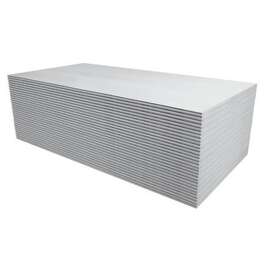
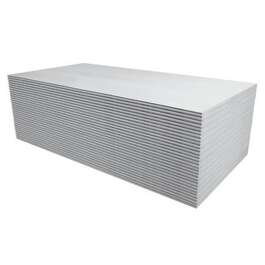
Standard gypsum board (drywall) is a sheet building material consisting of a gypsum core faced on both sides with paper. It is used for building partition walls, lining walls, and creating suspended ceilings in dry living spaces such as bedrooms, living rooms, hallways, and offices.
How do you order standard gypsum board from Sitypro.com?
Drywall and all related materials — profiles, anchors, primers, and fillers — are available in the 'Building Materials → Building Boards / Drywall' section at sitypro.com. Delivery throughout Estonia. For stock enquiries and orders: +372 536 16980.
What are the standard sizes and thicknesses of drywall sheets?
The most common sheet sizes are 1200×2500 mm and 1200×3000 mm. Thickness depends on the application: 9.5 mm for ceilings and curved structures, 12.5 mm as a universal option for walls and partitions, and 15 mm for reinforced structures with higher rigidity requirements.
How does standard drywall differ from moisture-resistant and fire-resistant types?
Standard drywall (grey paper) is intended exclusively for dry rooms. Moisture-resistant drywall (green paper) contains hydrophobic additives and is used in bathrooms and kitchens. Fire-resistant drywall (pink/red paper) is reinforced with glass fibres and is used near heat sources and in fire-rated assemblies.
What type of profile is needed for drywall installation?
Two main profile types are used for the frame: track profile (UW) — fixed to the floor and ceiling to define the structure boundaries; stud profile (CW) — inserted into the tracks and serves as the base for attaching the boards. Stud spacing is 400 or 600 mm depending on load and board width.
How many layers of drywall are needed for a partition wall?
For an interior partition in a residential space, one layer of 12.5 mm on each side of the frame is sufficient. Two layers are used to improve sound insulation, increase strength and fire resistance — particularly in apartment buildings or offices.
How do you correctly attach drywall to the profile?
Boards are fixed with metal screws 25–35 mm long at 150–200 mm spacing along the edges and 250–300 mm in the centre of the board. The screw head should be countersunk 0.5–1 mm below the surface to allow smooth filling. Board joints must fall on a profile.
How do you fill the joints between drywall sheets?
Joints are filled in 2–3 passes with full drying between each coat. Knauf paper tape is recommended for reinforcement — it is stronger than mesh tape and prevents cracks at joints. Factory-tapered edges require less material; cut straight edges should be manually bevelled at 45° for better compound penetration.
Can drywall be installed alone?
Ceiling installation alone is extremely difficult — it requires at least two people or a special board lift. Wall panels can be installed solo with experience using temporary supports or T-shaped installation stands.
What load is permitted on a drywall partition?
A drywall partition without additional reinforcement can support a suspended load of up to 15–20 kg per toggle bolt anchor. For shelves, cabinets, and TVs weighing more than 25–30 kg, wooden blocking must be inserted into the frame in advance at the intended fixing points.
Should you choose 400 mm or 600 mm profile spacing?
600 mm spacing is only acceptable for standard walls with 12.5 mm board followed by painting or wallpaper. In all other cases, a maximum spacing of 400 mm is recommended: for ceilings, double-layer cladding, high-load areas, and also mandatory for walls in bathrooms and any surfaces intended for tiling.
How do you cut drywall at home?
Drywall can be cut without power tools: score the paper face with a sharp utility knife along a straightedge, snap the board along the cut line, then cut the back paper. Edges are finished with a drywall rasp or sandpaper. For shaped cutouts, a jigsaw is more practical.
How do you achieve good sound insulation in a drywall partition?
Sound insulation depends on several factors: the thickness and number of drywall layers, filling the frame cavity with mineral wool, using acoustic isolation tape under profiles, and employing a double or staggered stud frame. A simple single-layer partition with mineral wool provides approximately 40–42 dB of sound insulation.
Can tiles be laid on drywall?
Standard drywall is not suitable for tiling in wet areas. In dry rooms — such as a niche or decorative feature — tiles can be applied to standard drywall using flexible tile adhesive. For bathrooms and kitchens, moisture-resistant drywall (GKLV) or a cement board must be used.